


As 4K, 8K, and high-frame-rate entertainment become the standard in 2025, traditional copper HDMI cables are reaching their physical limits.
When cable runs exceed 15 feet, even premium “Ultra High Speed” HDMI 2.1 cables can suffer signal loss, flickering, or handshake errors.
That’s where Active Optical Cables (AOC) step in — combining the best of fiber-optic and HDMI technologies to deliver long-distance, loss-free transmission ideal for Canadian homes, studios, and corporate AV environments.
What Exactly Is an AOC Cable?
An Active Optical Cable uses optical fiber to transmit the high-speed data portion of the HDMI signal while keeping standard copper conductors for power and control.
Built-in micro-converters on each end translate electrical HDMI signals to optical and back — enabling up to 100 metres (328 ft) of flawless 4K / 8K transmission.
| Component | Function |
|---|---|
| Optical Fibers | Carry the high-speed TMDS data channels (video + audio) |
| Copper Wires | Handle power (5 V) and auxiliary channels (EDID, HDCP) |
| Integrated Chipsets | Convert electrical ↔ optical signals in real time |
Why AOC Beats Traditional HDMI for Long Runs
- Zero Signal Degradation
Fiber-optic transmission resists electromagnetic interference, ensuring clean, stable 4K / 8K output over distances where copper fails. - Ultra-High Bandwidth
Certified HDMI 2.1 AOCs deliver up to 48 Gbps, supporting 4K @ 120 Hz, 8K @ 60 Hz, HDR10+, and eARC without compression. - Lightweight & Flexible
AOCs are thinner and lighter than long copper cables, making them easier to route behind walls, ceilings, and TV mounts. - Plug-and-Play
No external power or setup — simply connect the labeled “Source” and “Display” ends, and the cable’s chipset handles conversion automatically. - Future-Proof Investment
With HDMI 2.1 becoming standard across TVs, projectors, and GPUs, an AOC cable purchased today will remain compatible for years.
Copper HDMI vs AOC – Distance, Bandwidth & Stability
| Connection Type | Typical Length | Max Resolution & Refresh | Bandwidth (Gbps) | Long-Run Stability |
|---|---|---|---|---|
| Standard copper HDMI 2.0 | 1–5 m | 4K @ 60 Hz | 18 Gbps | Stable at short distances; issues above ~7–10 m |
| Premium copper HDMI 2.1 | 3–7 m | 4K @ 120 Hz (short runs only) | Up to 48 Gbps (theoretical) | Performance can drop on longer or lower-quality runs |
| Active Optical Cable (HDMI AOC 2.1) | 10–50+ m | 8K @ 60 Hz / 4K @ 120 Hz | 48 Gbps (sustained) | Designed for long-distance, interference-free transmission |
Copper HDMI Cables
- Work well for short distances behind a TV or PC monitor.
- Ideal for basic 4K setups where cable length stays under 5–7 m.
- Costs less initially, but may need boosters or replacements on longer runs.
Active Optical Cables (AOC)
- Designed to carry full 4K/8K bandwidth over 10–50+ m without signal loss.
- Immune to electromagnetic interference in walls, ceilings, and conduits.
- Thinner and lighter, easier to route in tight spaces and through conduits.
Which one should you use?
- For a living-room TV and streaming box: copper HDMI is often enough.
- For a projector, long wall runs, or 4K/120 Hz gaming at a distance: AOC is the safer, future-proof option.
- For in-wall installations: choose certified AOC to avoid expensive re-cabling later.
Common Use Cases in Canada
- Home theatre systems connecting AV receivers to 4K/8K projectors 20–100 ft away
- Digital signage in malls, airports, and retail displays where long reliability is essential
- Conference rooms and hybrid offices needing crisp, zero-lag video at long distances
- Gaming setups linking high-end PCs or consoles to large OLED displays without signal loss
Cost vs Performance — Are AOCs Worth It?
While a 10-metre copper HDMI 2.1 cable might cost less, performance quickly deteriorates beyond 5 metres.
In contrast, a 15–30 m AOC maintains full 48 Gbps performance — no repeaters, no boosters, no lag.
For installations where rewiring is expensive (in-wall or ceiling), the slightly higher upfront cost of an AOC pays off in stability, longevity, and signal integrity.
AOC as a Long-Term Investment
Higher than basic copper
- AOC cables typically cost more than short copper HDMI leads.
- However, they replace the need for boosters, repeaters, or multiple cable segments on long runs.
Less troubleshooting & rewiring
- Reduces “invisible” costs: time spent diagnosing flicker, dropouts, or handshake issues.
- Lower chance of having to open walls or ceilings again to replace a weak cable.
Built for 4K/120 & 8K
- Supports current 4K/120 Hz and upcoming 8K content without a cable upgrade.
- Ideal if you plan to upgrade your TV, projector, or GPU in the next few years.
Real-World Example: PrimeCables AOC HDMI 2.1 Cable
The PrimeCables Ultra High Speed AOC HDMI 2.1 Cable exemplifies why AOCs dominate long-distance setups in 2025:
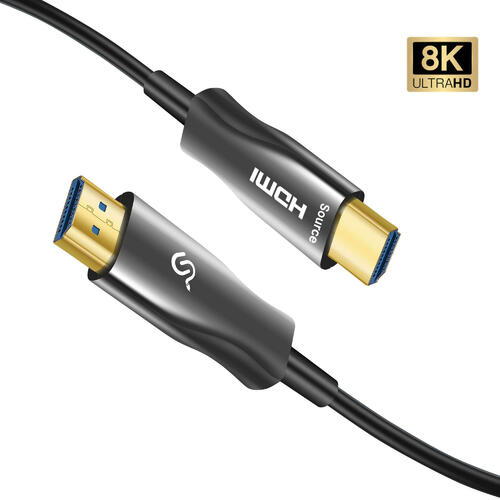
- Supports 8K @ 60 Hz / 4K @ 120 Hz with HDR10+ and eARC
- Transmits reliably up to 50 m with zero latency
- Uses hybrid fiber-copper construction with reinforced zinc-alloy connectors
- Fully compatible with PS5, Xbox Series X, RTX 40 GPUs, and 8K TVs
Such models combine professional-grade performance with affordable Canadian pricing, making them the go-to option for advanced home theatres and gaming systems.
Conclusion — The Future Is Optical
Copper HDMI cables served faithfully for decades, but the era of 4K 120 Hz and 8K HDR demands more bandwidth and distance than metal conductors can provide.
Active Optical Cables (AOC) deliver the solution: longer runs, lighter weight, cleaner signals, and true next-generation readiness.
For Canadian consumers upgrading TVs, consoles, or AV setups in 2025, switching to an HDMI AOC means investing once — and enjoying uncompromised performance for years.
FAQ — Active Optical Cables in 2025
Q1. Are AOC HDMI cables compatible with regular HDMI devices?
Yes. They are fully plug-and-play with standard HDMI ports — no extra drivers or power required.
Q2. Can I use an AOC cable for gaming?
Absolutely. AOCs handle 4K @ 120 Hz, VRR, and ALLM, making them ideal for PS5, Xbox Series X, and PC gaming.
Q3. Do I need a special HDMI 2.1 port to use AOC?
No. AOCs are backward-compatible with HDMI 2.0 / 1.4 devices; they simply future-proof your setup for 8K and beyond.
Q4. Can I bend or coil AOC cables tightly?
Avoid sharp bends — fiber can be damaged. Use gentle loops and protect the cable during installation.


