The Canadian winter landscape—defined by freezing rain, aggressive ice accretion, and high winds—continues to stress electrical infrastructure, causing city-scale, multi-day disruptions.
Recent, verifiable cases:
- Montréal & surrounding (QC), Apr 5–11, 2023 — Freezing rain and wind caused tree/branch strikes on lines; utilities reported ~1.125 million customers affected at points and multi-day restoration. (Source: Hydro-Québec official updates, Updated: 2023-04/05–11.)
- Ontario (incl. GTA/Barrie), Mar 30–Apr 1, 2025 — Accreting freezing rain and wind left 350,000+ Hydro One customers without power; ~35,000 Alectra customers were out around Barrie; restoration spanned several days. (Source: National Newswire; Utility Releases; Local Coverage, Updated: 2025-03/31.)
Implication: Plan for ≥ 1 full day of autonomy; if you’re on tree-lined feeders or rural laterals, size for 2–3 days.
Why LiFePO₄—and Its Cold-Weather Caveats
Lithium Iron Phosphate (LiFePO₄, LFP) has become the preferred chemistry for home and portable energy storage due to thermal stability, predictable output, and long cycle life. Selecting an LFP backup that truly works in winter hinges on four pillars:
- Strict cold-charge rules
- Intelligent BMS behavior (low-temp charge cutoff and, ideally, self-heating)
- Safety standards for fixed ESS (UL 1973 / IEC 62619, when applicable)
- Realistic, winter-adjusted sizing (1–3 days of autonomy)
This guide details the decisions for true winter resilience, then maps them to a neutral 600 W / 512 Wh portable example to clarify scope and limits.
The Winter-Adjusted Sizing Method (Step-by-Step)
Step 1 — Define critical loads
| Critical Load | Avg. Watts | Hours/Day | Raw Wh/Day | Notes |
|---|---|---|---|---|
| Gas Furnace Blower / Circulator | 500 | 4 | 2,000 | Intermittent; essential for heat circulation |
| Refrigerator / Freezer | 120 | 10 | 1,200 | Cycling average; essential for food safety |
| Modem / Router / ONT | 20 | 24 | 480 | Continuous; communication and safety alerts |
| LED Lighting (3 rooms) | 30 | 5 | 150 | Task lighting |
| Raw Daily Total | — | — | 3,830 | ≈ 3.83 kWh |
(Source: Utility Restoration Windows; Field Load Ranges, Updated: 2023–2025.)
Step 2 — Apply a winter margin
Derating covers inverter idle, cold losses, and potential BMS/self-heater draw. Adjusted Daily Requirement≈3.83 kWh×1.30≈5.0 kWh\text{Adjusted Daily Requirement} \approx 3.83 \text{ kWh} \times 1.30 \approx \mathbf{5.0\ kWh}Adjusted Daily Requirement≈3.83 kWh×1.30≈5.0 kWh
Typical home with heat circulation and refrigeration needs ~5.0 kWh usable per day in winter.
Step 3 — Choose system voltage and autonomy
| Target Autonomy | Capacity Calculation | Recommended LFP Bank (usable) |
|---|---|---|
| 1 Day | 5.0 kWh × 1 | 5.0–6.0 kWh |
| 2 Days | 5.0 kWh × 2 | 10.0–12.0 kWh |
| 3 Days | 5.0 kWh × 3 | 15.0–20.0 kWh |
For multi-day coverage under multi-kilowatt loads, 48 V architectures with 2–5 kW inverters are common.
Spec Sheet Essentials (2025 Checklist)
A) Safety & regulatory (fixed ESS)
- UL 1973 (pack-level safety for stationary/auxiliary) — ask for listing or report IDs.
- IEC 62619 (industrial lithium cells/packs) — complementary evidence of safety.
- UN 38.3 (transport test summary) — required for shipping.
(Source: UL / IEC / UN Official Overviews, Updated: 2024–2025.)
B) Cold-charging strategy (the thermal decider)
- BMS low-temp charge cutoff ≈ 0 °C (auto re-enable on warm-up)
- Self-heating (BMS-managed) for unconditioned spaces
- Charge window (e.g., 0–45 °C) and typical ≤ 0.5 C charge rates
(Source: Manufacturer Cold-Charging Guidance; Technical Notes, Accessed: 2025-12.)
C) Performance & integration
- Cycles at stated DoD (e.g., ≥ 3,000–3,500 @ 80 % DoD)
- Continuous & surge discharge ratings (motor starts matter)
- Discharge temperature spec (often down to −20 °C)
- Telemetry (Bluetooth/Wi-Fi/CAN/RS-485) with cell temperature visibility
- Inverter/charger certified to CSA C22.2 No. 107.1 (Canada)
What a 512 Wh Portable Can—and Cannot—Do
PrimeCables 600 W Portable Power Station with Wi-Fi — 512 Wh
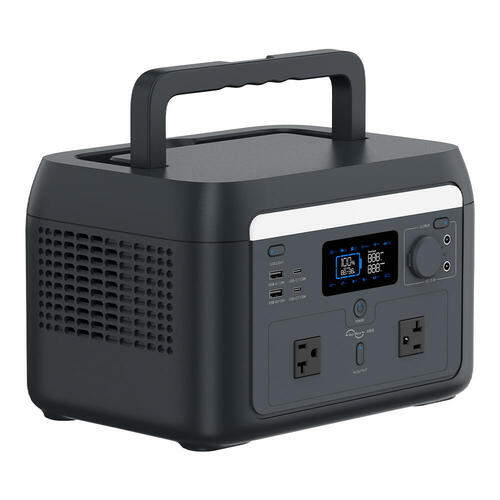
Key characteristics:
- Safety & docs: Declares UN 38.3, CB, TSCA, REACH, WEEE, MSDS. UL 1973 / IEC 62619 are not claimed → treat as portable power station, not a fixed residential ESS subassembly.
- Power & UPS: 600 W nominal AC; ≤ 10 ms UPS transfer (typical IT loads tolerate this; verify onsite).
- Charging & continuity: Bidirectional fast charge (≈ 1.5 h AC); simultaneous charge + discharge; inputs: AC / solar PV / 12.6 V-10 A car.
- Thermal & chemistry: LiFePO₄ cells in aluminum-cased pack; intelligent air-cooling (assume room-temperature charging unless enclosure warms cells ≥ 0 °C).
- Longevity & telemetry: ≥ 3,000 full cycles (minimum statement); Wi-Fi/BT via Tuya& S+ Smart apps.
- Grid compatibility: Auto-detects input 50/60 Hz; adjusts output frequency.
How long will 512 Wh last?
For AC use, assume ~88 % inverter efficiency at room temperature:
- Usable AC energy (room temp): 512 × 0.88 ≈ 451 Wh
- Usable AC energy (~0 °C winter factor × 0.85): ≈ 383 Wh
Runtime ≈ usable Wh ÷ load W:
| Load Scenario | Room Temp Runtime | ~0 °C Runtime | Notes |
|---|---|---|---|
| Modem + Router (20 W) | ≈ 22.5 h | ≈ 19.1 h | Communication bridge |
| Laptop + Small Light (60 W) | ≈ 7.5 h | ≈ 6.4 h | Work-from-home continuity |
| Refrigerator (120 W avg.)* | ≈ 3.8 h | ≈ 3.2 h | Cycling; varies |
| Mixed Essentials (~150 W) | ≈ 3.0 h | ≈ 2.6 h | Fridge + comms + light |
| High Draw (500 W) | ≈ 0.9 h | ≈ 0.77 h | Short bursts only |
* Refrigerators are intermittent loads; runtime varies with ambient temperature and door openings.
Conclusion (neutral): A 512 Wh portable is excellent for short-duration essential loads (communications, lighting, small devices) and as a UPS bridge, but it does not replace a 10 kWh+ fixed system needed for multi-day heat and refrigeration.
Upgrading Path: From Portable to Multi-Day Fixed ESS
| Specification Area | Portable (512 Wh) | Multi-Day Fixed ESS (10 kWh+) | Rationale |
|---|---|---|---|
| Usable Capacity | ~0.38–0.45 kWh (winter vs. room temp) | ≥ 10 kWh | Meets ~5 kWh/day for 2+ days |
| Continuous Power | 600 W | 2–5 kW | Run furnace + fridge + lights |
| System Voltage | Low (≈ 12 V) | 48 V | Efficient high-current delivery |
| Safety Listings | UN 38.3; CB; TSCA/REACH/WEEE | UL 1973 / IEC 62619 (+ UN 38.3) | Required for fixed residential ESS |
| Thermal Strategy | Air-cooled | BMS self-heating + cutoff | Safe cold charging in unconditioned spaces |
| Integration | Wi-Fi/BT apps | CAN/RS-485 + Hybrid inverter | Deep telemetry & control |
| Inverter Standard (CA) | — | CSA C22.2 No. 107.1 | Safety/compatibility with premises wiring |
(Sources: UL 1973; IEC 62619; CSA 107.1; UN 38.3; Manufacturer Cold-Charge Guidance, Updated/Accessed: 2021–2025.)
Practical Installation & Operation
- Location & insulation: Prefer semi-conditioned spaces; for garages/outbuildings, use insulated enclosures.
- Charging rules: At/near freezing, pause or reduce current; enable BMS self-heating where available.
- Wiring & protection: Short DC runs; correct gauge; class-T/ANL fusing near the battery per inverter guidance.
- UPS rehearsal: Test ≤ 10 ms transfer with your own router, NAS, and workstation.
(Source: Manufacturer Cold-Charging Guidance; CSA 107.1 context, Accessed/Updated: 2021–2025.)
Quick Decision Tree
- Need comms + lights for hours, not days → A 512 Wh portable is appropriate; add PV/vehicle recharging to stretch runtime.
- Occasional heat circulation → Check surge and duty cycle; keep average power modest; treat the portable as a bridge.
- Expect multi-day storms → Size a larger fixed bank (≥ 10 kWh usable) with a CSA 107.1 inverter/charger.
- AHJ or insurance requires documentation → Request UL 1973 / IEC 62619 proof (pack-level) and UN 38.3 test summaries.
FAQs
Q1: Can I safely charge LiFePO₄ below 0 °C?
Avoid it. Charging below freezing risks lithium plating. Either pre-heat cells above 0 °C (BMS-managed self-heating) or delay charging; if charging must occur near freezing, reduce current to ~0.1 C. (Source: Manufacturer Cold-Charging Guidance; Technical Notes, Accessed: 2025-12.)
Q2: How much extra capacity for the cold?
Add a 25–35 % Winter Margin above room-temp sizing to cover cold derating, inverter idle, and heater/BMS draw. (Source: Outage Restoration Windows; Manufacturer Guidance, Updated: 2023–2025.)
Q3: Which standards matter for residential backup?
UL 1973 / IEC 62619 for battery packs used as fixed ESS; UN 38.3 for transport; CSA C22.2 No. 107.1 for inverter/chargers in Canada. (Source: UL, IEC, UN, CSA Overviews, Updated/Accessed: 2021–2025.)
Q4: Will a 600 W portable run my gas furnace continuously?
No. It may bridge short blower cycles, but 512 Wh capacity and 600 W output are insufficient for sustained heating. Multi-day heat + refrigeration requires a 10 kWh+ bank. (Source: Runtime math above.)
References
- Hydro-Québec — Ice storm updates & resilience actions (April 2023). (Source: Official Utility Resource, Updated: 2023-04/05–11)
- Ontario Ice Storms (Mar 30–Apr 1, 2025) — Utility totals and restoration timelines (Hydro One; Alectra; local coverage). (Source: Newswire + Utility Releases, Updated: 2025-03/31)
- UL 1973 — Batteries for Stationary and Auxiliary Power Applications. (Source: Official Standard Overview, Updated: 2024–2025)
- IEC 62619 — Safety requirements for secondary lithium cells and batteries for industrial applications. (Source: Standard Overview, Updated: 2022–2024)
- UN 38.3 — UN Manual of Tests and Criteria, Part III, 38.3. (Source: Official Resource, Ongoing)
- CSA C22.2 No. 107.1 (R2021) — Power conversion equipment (inverter/chargers). (Source: CSA Group, Updated: 2021)
- Manufacturer Cold-Charging Guidance (LFP) — Avoid charging below 0 °C; reduced currents near freezing. (Source: Technical Guidance, Accessed: 2025-12)
- Internal Product Data — PrimeCables 600 W Portable Power Station, 512 Wh (CAB-SR0KW6L-SG1-US). (Source: Internal, Updated: 2025-12)