You’re upgrading to faster internet—maybe even eyeing 2.5 Gbps or 10 Gbps service—and suddenly the weakest link isn’t your router, it’s the cable hidden in your walls. Is that old Cat5e run still good enough? Do you really need Cat6a? And in a dense Canadian condo full of elevators, power lines, and Wi-Fi noise, does shielded cable actually matter?
This guide breaks down Cat5e, Cat6/6a, and Cat7 in plain language, with Canada-specific realities in mind. You’ll get speed-and-distance limits, shielding advice for apartments, and a practical approach to future-proofing without overspending.
The One-Minute Answer
- Cat5e: Fine for 1 Gbps and short 2.5 Gbps runs; not future-proof for 10 Gbps.
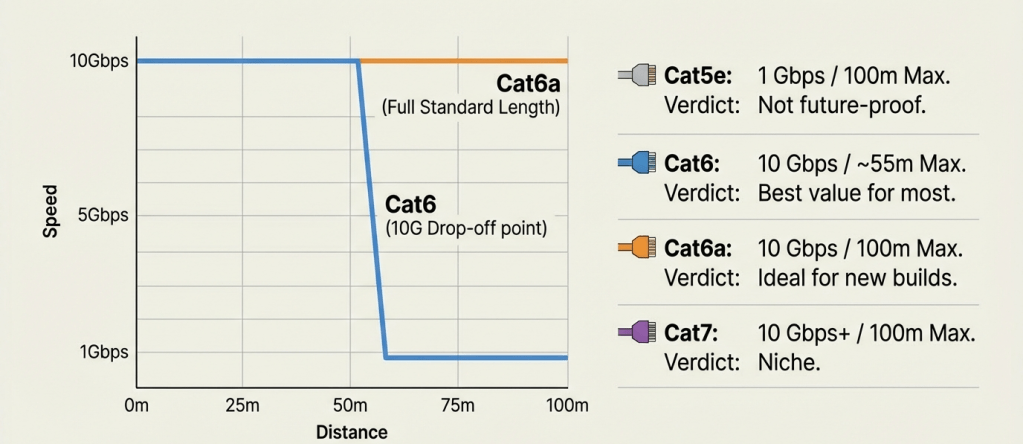
- Cat6: The current sweet spot for most homes; supports 10 Gbps up to ~55 m.
- Cat6a: Best choice for full-length 10 Gbps (100 m) and noisy environments.
- Cat7: Overkill for most homes; limited benefit without matching hardware.
If you’re opening walls in 2026, Cat6a is the safest long-term bet in Canada.
Why Ethernet Category Matters More in 2026
Canadian ISPs are steadily rolling out multi-gigabit plans, and modern homes are packing more interference sources:
- Dense Wi-Fi 6/6E/7 networks
- Elevator motors and electrical risers in condos
- Power-over-Ethernet (PoE) cameras and access points
Ethernet cable category determines how much speed you can carry, how far you can carry it, and how clean the signal remains in real buildings—not just on spec sheets.
Speed & Distance Comparison
| Category | Rated Speed | Max Distance (Typical) | Shielding | Real-World Verdict (Canada 2026) |
|---|---|---|---|---|
| Cat5e | 1 Gbps | 100 m | UTP | Adequate for legacy wiring; not future-proof |
| Cat6 | 10 Gbps | ~55 m (10G) | UTP/STP | Best value for most homes |
| Cat6a | 10 Gbps | 100 m | Usually STP | Ideal for condos & new builds |
| Cat7 | 10 Gbps+ | 100 m | S/FTP | Niche; limited consumer benefit |
Key point: 10 Gbps distance limits matter. Cat6 can do 10G—but only reliably on shorter runs. Cat6a does it end-to-end.
Shielded vs Unshielded: Do Canadian Homes Need STP?
Short answer: sometimes, and it depends on the building.
When unshielded (UTP) is fine
- Detached homes or townhouses
- Short runs (<30–40 m)
- Minimal electrical interference
When shielded (STP/FTP) makes sense
- High-rise condos and apartments
- Cable runs near power conduits or elevator shafts
- Multiple PoE devices drawing higher current
Cat6a is commonly shielded by design, which is one reason it performs better in noisy environments. Just remember: shielding only works if properly grounded.
Future-Proofing Your Network
Ask yourself three questions:
- Will this cable be hidden behind drywall?
- If yes, upgrade now. Labour costs dwarf cable costs.
- Do you expect 10 Gbps devices within 5–10 years?
- Work-from-home, NAS, media servers → likely yes.
- Is this a condo or mixed-use building?
- Interference risk pushes you toward Cat6a.
Rule of thumb:
- Patch cords → Cat6 is usually enough
- In-wall, long-term runs → Cat6a
Home Network Upgrade Scenarios
| Scenario | Recommended Cable | Why |
|---|---|---|
| Older house, existing Cat5e | Keep for now | 1 Gbps still practical |
| New router + NAS | Cat6 | Handles short 10G links |
| Condo renovation | Cat6a | Noise resistance + full 10G |
| Home lab / server rack | Cat6a | Predictable performance |
| Audio/video over Ethernet | Cat6 or Cat6a | Lower error rates |
Where PrimeCables Fits in the Canadian Network Landscape
PrimeCables has become a familiar name among Canadian homeowners and IT enthusiasts because it focuses on networking essentials that meet real-world installation needs—from bulk Ethernet cable to finished patch cords designed for residential and small-office environments. The brand’s emphasis on durability, clear specifications, and Canada-ready availability makes it a practical choice when upgrading networks meant to last through multiple ISP and hardware cycles.
Common Myths
- “Cat7 is always better.”
Not unless your connectors and equipment support it. Most consumer gear doesn’t. - “Shielding boosts speed.”
Shielding reduces interference; it doesn’t increase rated bandwidth. - “Any Cat6 can do 10 Gbps everywhere.”
Distance and installation quality matter—a lot.
FAQ
Q1: Can Cat5e handle 2.5 Gbps or 5 Gbps?
Often yes on short, clean runs, but it’s not guaranteed.
Q2: Is Cat6a harder to install?
It’s thicker and stiffer, so planning bends and boxes matters—but the payoff is stability.
Q3: Should I wait for Cat8?
Cat8 targets data centres. For homes, Cat6a is the realistic ceiling for the next decade.
Q4: Do I need shielded connectors with STP cable?
Yes. Shielding must be continuous and properly grounded to be effective.
Sources (Accessed/Updated: 2026)
- TIA-568 & TIA-568.2-D — Twisted-pair cabling standards and performance categories
- ISO/IEC 11801 — International generic cabling standards
- IEEE 802.3 — Ethernet speeds (1G, 2.5G, 5G, 10GBASE-T)
- CCOHS / CSA Group — Canadian guidance on low-voltage cabling and building environments